Watchkeeper Is a Tiny Free Browser That Shows You Who Is Watching
Open a news article and you see a headline, some text and an ad or two. You don’t see the other companies the page told about your visit while it loaded. On many news sites that list runs to a dozen names or more, and nothing in a normal browser window mentions any of them.
Watchkeeper is a small browser built to show that list. You type an address and use the page as you would anywhere else. A panel on the right fills in as the page works: the other sites it contacts, the cookies it leaves, the keys it writes to your computer and the scripts that read your device’s fingerprint.
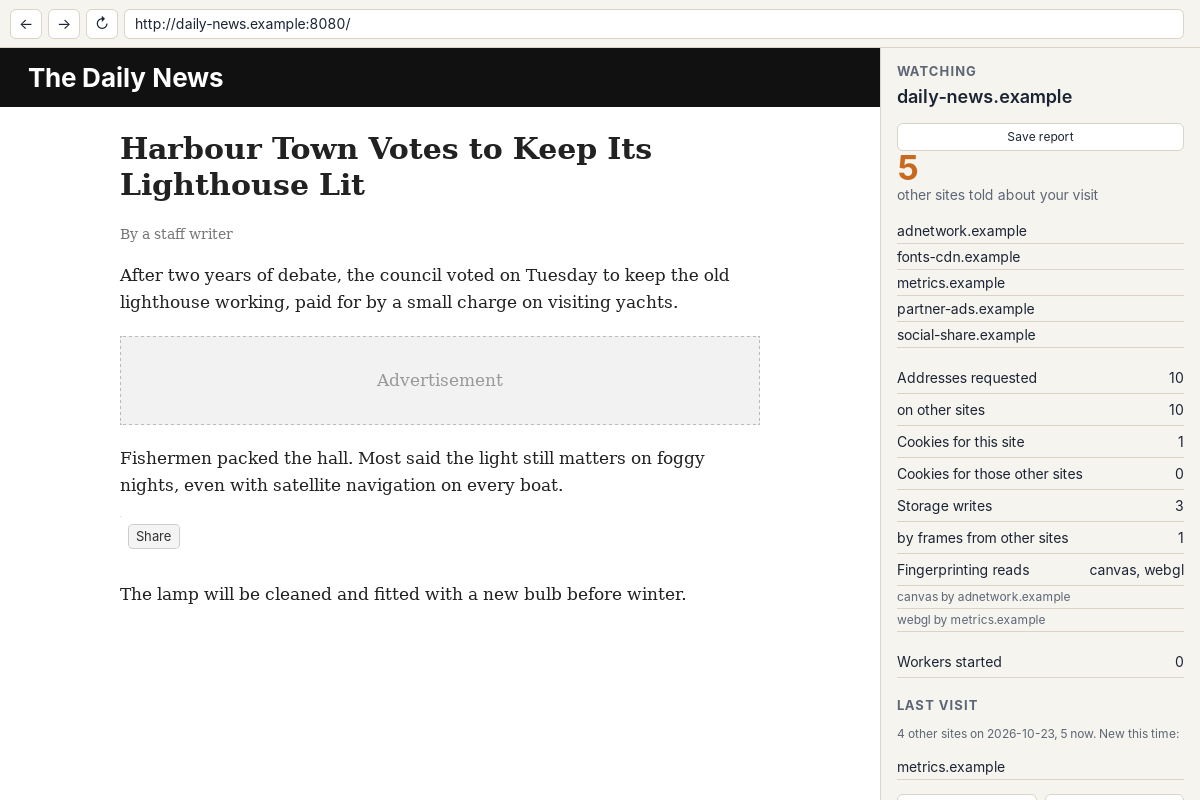
A test page served on the same machine. Real sites usually list more.
What It Shows
The big number at the top of the panel is how many other sites heard about your visit. Under it come the sites themselves, then the counts behind them. You get every distinct address the page asked for, the cookies in the engine’s own store (including the ones scripts can’t see), and storage writes, including those made by frames from other sites.
Fingerprinting gets its own line. Reading back a drawn canvas, asking WebGL for your graphics card or making an offline audio context are the usual building blocks of a device fingerprint, and the panel names the site whose script did each one: “canvas by adnetwork.example”. A read is a sign, not proof. Some sites draw on a canvas for ordinary reasons.
Version 0.3 adds two more things. The Last visit section compares today with your previous visit to the same site and names any newcomers. And Save report writes everything the panel knows to an HTML page and a JSON file, ready to keep or send to a site’s owner.
What It Doesn’t Do
Watchkeeper doesn’t block anything. If it did, you’d see a page that behaves differently from the one everybody else gets. Instead each session starts empty and is thrown away when you close the app, so whatever a tracker leaves behind doesn’t follow you to the next one.
It also says plainly what it can’t see. Requests made from inside workers stay out of sight, a beacon fired as you leave a page can slip past, and engines hold back some details of other sites’ frames. Those gaps are listed in the reference and in every saved report.
Small on Purpose
Watchkeeper borrows the web engine your system already has: WebView2 on Windows, WKWebView on macOS, WebKitGTK on Linux. That keeps each installer at about 2 MB. It’s written in Rust with Tauri 2, and the code is open source under the Apache License 2.0.
The download page has installers for Windows, macOS and Linux. Each one ran the full self-test on its own system before it was published, and how it was tested is a post of its own.